
The Illegal Drug Trade | ISSUE #4 / APR 2022
- Apr 30, 2022
- 13 min read
Updated: Jan 31, 2023
April News Highlights

The Illegal Drug Trade
Trade makes up an important part of our lives; after all, it is a universally known principle that trade makes everyone better off. The world is a complex and interconnected webbing of transactions and interactions, and it functions according to how people trade money for services, cash for goods, and time for products. We partake in a non-exhaustive list of transactions in our daily lives because without them, society would struggle to conveniently obtain what they want.
This theory does not just apply to our everyday lives; it can also be seen in the trades of the drug trafficking industry. Although an illegal trade, it shares many of the same characteristics as the legal trades that we engage in in our daily lives. These transactions are, of course, hidden to the world that we see and are a part of, but it is still a business that lives and runs just the same. There are buyers and sellers, there is a demand and a supply, and there exists an entire network and system of production, distribution, and smuggling.
The illegal drug trade, or narcotrafficking, is one of the underworld’s fastest-moving and lucrative markets. From opium to marijuana; from cocaine to meth; from ecstasy to heroin; there is a wide variety of types of drugs available. The market is known to be in a constant motion with its ever-present demand and supply. It is a trade that spans the entire globe, and comprises hundreds of routes, people, and countries. Although it is a criminal activity, it has been estimated to make up 1% of global trade, making it one of the most popular black markets in existence. In 2014, think tank Global Financial Integrity approximated the market’s GDP to be valued at US$78 trillion; a number unexpectedly high given its illegal status. Because of its illicit label, however, it is virtually impossible to trace and track every single transaction that generates the revenue from drug trafficking. It involves industries of all sorts; from financial contractors to transportation networks, there are many players in the drug trafficking industry.
The topic of drug trafficking is a broad umbrella of many subtopics. From its first discoveries to the First Opium War; from the 1868 Pharmacy Act to the rise of the many drug cartels and syndicates today, the drug trafficking world contains an extensive history that is filled with a series of events that have shaped the massive drug industry of today.
History
Drugs have been a consistent presence throughout history even before they were associated with their addictive qualities and ties to illegal activity. Historical records have shown its importance and its many uses, and many of them are related to providing healthcare and medicinal benefits. Medieval doctors used opiates for pain control as they were especially known for having anesthetic purposes. They have also been used in religious ceremonies by priests, as well as for recreational purposes among the general public.
Till this day, drugs are still a crucial aspect of the healthcare and pharmaceutical industry and are commonly used in forms such as morphine (derived from opium). However, their addictive and high properties have also made them very attractive for money-making, which encouraged cartels, traffickers, and even businesspeople to invest in the business and engage in its related activities. While many countries condemn drug trafficking and recognise it as a serious problem that needs urgent fixing, others cannot deny the fact that a business is a business. In areas like Latin America, for example, the revenue that drug trafficking brings in is such a massive amount that it is recognisable as an economic contribution. In Bali, Indonesia, part of the charm of the place lies within the opportunity to have some fun with party drugs, so much so that it is infamously known for such activities.

First Opium War - 1843
One of the most notable events that shaped and defined the course of drug trafficking history was the First Opium War. Also known as the Anglo-Chinese War, it lasted from 4th September 1839 to 29th August 1842, with a duration of 2 years, 11 month, 3 weeks, and 4 days. It entailed a series of military engagements between Britain and the Qing dynasty, who were both fighting for the right to continue the opium trade. The disagreement and the resulting war emerged when a trade imbalance between China and Britain came to light. The British were steered by the principles of free trade and equal diplomatic recognition among nations and were therefore in heavy support of the merchants’ demands to continue trading opium. The Chinese, on the other hand, were adamantly against allowing opium trade and sought to enforce a death penalty for offenders.
During this time, in the 18th century, trade by sea was a common affair. The Chinese would trade silk, porcelain, and tea, while the British would trade European silver. The British found that, because of the Canton system (a cautionary measure enacted by the rulers of the Qing dynasty to confine and regulate foreign trade to the southern port city of Canton), demand for their goods were outweighed by the demand for Chinese goods. The British looked to even out the imbalance by growing opium in Bengal and allowing private British merchants to illegally sell opium to Chinese smugglers. This consequently resulted in damage to the Chinese trade network; there was now a lesser demand for silver, Chinese trade no longer reigned supreme, and the number of opium addicts within the country began steadily increasing.
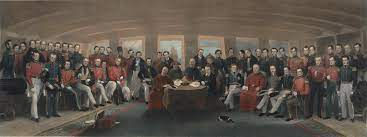
The Signing of the Treaty of Nanking (1842)
It was at this point that early concerns surrounding addiction began. Chinese officials worried about the dominating effects of the opium trade, and therefore rejected proposals to legalise and tax opium. Blockades on foreign ships were enforced, and drug supplies were seized and destroyed. This, of course, angered the British, who had found great success and demand in the trading of opium. Thus, a war ensued, and the British dispatched the Royal Navy force to China. After a series of decisive defeats pummeled the Chinese Empire, the Qing dynasty was forced to sign the Treaty of Nanking in 1842.
The outbreak of the First Opium War gave way to a series of events that would dictate how opium would change the course of drug history. The Chinese Empire was dissatisfied with the terms of the treaty, which led to the outbreak of the Second Opium War (1856 – 1860), and its corresponding Treaty of Tianjin. Both the Treaties of Nanking and Tianjin had terms that favoured the West; the Treaty of Nanking outlined that the Qing government had to allow the British to sell Indian-grown opium, while the Treaty of Tianjin stipulated that Chinese ports had to open ports to foreign trade, including opium.

A drawing depicting the circumstances which led to the 1868 Pharmacy Act
Although the terms of the Treaties had been dictated according to Western demands, by the late 19th century, the British found that addiction had become a problem. As a result, they enacted the 1868 Pharmacy Act, which was implemented to restrict the sale of poisons and dangerous drugs, including opium, to qualified pharmacists and druggists. It was the one of the first major 19th-century legislations surrounding drugs and was only succeeded by the signing of the International Opium Convention in 1912.
Between 1920 and 1933, alcohol was banned under the Eighteenth Amendment of the United States Constitution in an attempt to control the steadily rising consumption of addictive substances. However, substance addiction had rapidly increased and as such, a blanket wipe-out was no longer a feasible option. This gave way to the rise to organised crime, which included syndicates such as the Sinaloa Cartel, the Medellin Cartel, and ‘Ndrangheta, as well as the modern American Mafia. At this time, opium was still highly popular, but the world began to see an introduction to other substances like liquor, marijuana, cocaine, meth, ecstasy, and heroin.
Types of drugs trafficked
Some of the earliest records of opium use date back as far as 5000 BC, where it was commonly used in the Mediterranean region for purposes such as food, anesthetics, and rituals. In the centuries that followed, its unprocessed form was commonly used for medical reasons, until the American Civil War gave way to the development of morphine and other painkillers. Today, opium is still one of the most widely traded drugs around the world, but it shares its popularity with many other substances.
When investing in the production and distribution of a certain drug, manufacturers and smugglers would take into consideration whether they were profitable, valuable, in high demand, and easy to transport, among many other factors. Despite there being many considerations, it was often hardly a complicated decision as drug cartels would choose to go with any substance that was just in massive demand. At that time, when chemical technology was a relatively unexplored field and still in its primitive stages, natural drugs like opium (from the poppy plant), magic mushrooms, and marijuana (from the cannabis plant) were the top options for trade. This is hence why opium was such a lucratively massive trade business at the height of the drug trade in the 1800s; they were easier to produce, required cheap labour, and did not require much chemical or technological advancement. They were straightforward to grow, harvest, and sell, which was largely due to their natural characteristics.

An opium poppy field in Afghanistan
It was not until technology had made rapid advancements that synthetic drugs began taking over the industry. Readily available chemical ingredients and more affordable laboratory technology paved the way for the rise of synthetically-made drugs, making them more profitable to produce. Although cocaine is one of the most trafficked drugs today, opium and cannabis are still in high demand in places like Asia and North America, respectively. According to the 2021 UNODC World Drug Report location map of where each drug has its highest usage, it is clear to see that the opium trade is still largely prominent in Asia, cocaine in South America, and an expanding meth market all across the globe.

An Afghan farmer collects raw opium as he works in a poppy field in Khogyani District of Nangarhar province on April 29, 2013.
Opium, scientifically known as Papaver somniferum, is a natural drug derived from the dried latex of the opium poppy plant’s seed capsules. Although its exact geographic origins are unknown, information on drug routes indicates that they were first found somewhere in Asia, Spain, southern France, or northwestern Africa. Today, it is produced by Afghanistan, Myanmar, Colombia, Laos, and Mexico, as well as a few others. As one of the first types of drugs trafficked illegally across countries, it was highly popular in the 19th century and served as an important part of trading history. Scientific developments since then have produced several legal forms that are used in the medical industry; morphine and codeine are its most well-known.

A marijuana farm
Another natural drug is marijuana, a psychoactive drug derived from the Cannabis sativa, Cannabis indica, and Cannabis ruderalis plants. It is native to Central and South Asia and has been used for both recreational and medicinal purposes. Although primarily used for the former, recent law changes have allowed for marijuana to be legally used as they have been found to reduce anxiety, kill cancer cells, and aid with several medical conditions such as AIDS and multiple sclerosis, among many other benefits. Today, marijuana is legal in Canada, Georgia, Malta, Mexico, South Africa, and Uruguay, as well as 18 states in the US.
Methamphetamine is a synthetic drug that was first produced by a Japanese chemist in 1893. Also known as meth, crank, crystal meth, or speed, it was initially used to treat narcolepsy, asthma, and to stimulate weight loss but has since then been recognised as drug consumed for recreational purposes. Some of its legal forms are used to treat medical conditions; some examples are Adderall (amphetamine) and Ritalin (methylphenidate) which are both FDA-approved drugs used to treat ADHD and obesity. When used illegally, it is consumed in the form of a white powder as an aphrodisiac and euphoriant and gives the consumer a heightened sexual desire and an elevated mood.

Crystal meth
While most, if not all drugs, began with the purpose of improving medicine and healthcare systems, they eventually became known for their addictive, stimulating, and euphoric qualities. Cocaine, meth, and ecstasy are especially famed for their pleasuring effects, and are commonly seen in dance parties, raves, and EDM festivals. Although they had been initially developed to cure or aid in the treatment of diseases, the high that they gave upon consumption was an attractive feature that soon made them become the focus of trafficking systems. They rose in demand due to the effects of increased energy, empathy, and pleasure, and soon became a crucial part of the crime and cartel industry.
Drug trafficking routes and locations

Popular drug trafficking routes and sources
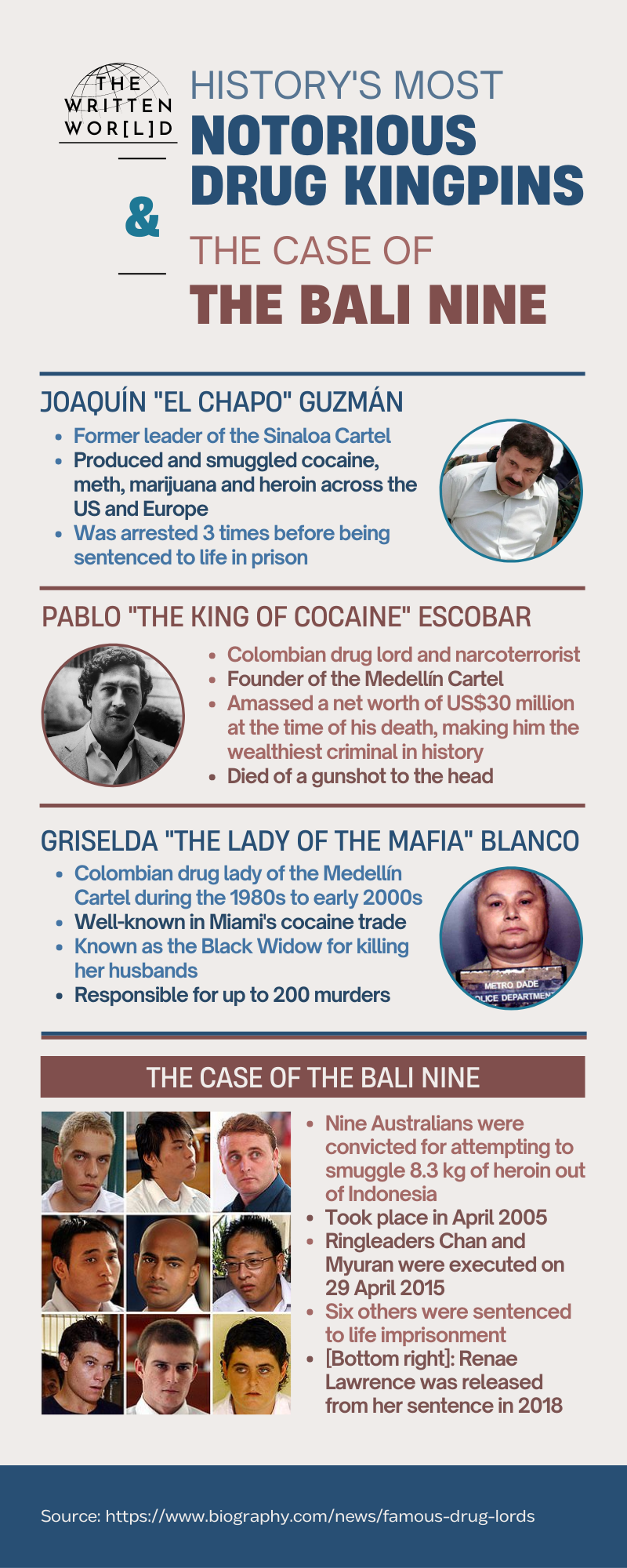
Drug trafficking activities take place all over the world, but there are several routes and locations that are recognised for their fundamental role in the drug trade. Latin America, South America and the Caribbean are especially infamous for their cartels and smuggling networks, and are world-renowned for being the epicentre of narcotrafficking, production, distribution, and smuggling. Some of history’s most notorious drug lords and ladies come from this part of the world; Colombia was home to Pablo Escobar (Medellin Cartel) and Griselda Blanco, Mexico saw the operations of Joaquin “El Chapo” Guzman (Sinaloa Cartel), and Venezuela served as an important hideout of the Cuntrera-Caruana Mafia clan. Because of their close geographic ties, near and neighbouring countries like Haiti, the Dominican Republic, and Puerto Rico, were also well-known for their involvement in illicit and frivolous drug-related activities.

Africa's main drug routes
West Africa is another popular location for narcotrafficking and is known for acting as a crossing point for supply movements. According to the United Nations Office on Drugs and Crime (UNODC), at least 50 tons of cocaine transit through West Africa every year. Their journey begins in the Andean countries of Colombia and makes its way through Guinea-Bissau in the north and Ghana in the south, where most of the drugs are then shipped to Europe by way of drug mules travelling on commercial flights. Upon arriving in Europe, they are distributed through West African criminal networks.

National Narcotics Agency in Jakarta (BNN) personnel present suspects of drug trafficking cases on May 21, 2019. (Antara/Risky Andrianto)
Although South America housed some of the biggest drug trafficking operations in the 20th century, Southeast Asia now dominates the illegal drug trade. In an area known as The Golden Triangle, comprising the regions of northern Thailand, Western Laos, and eastern Myanmar, media reports have estimated the total trade value of methamphetamine at over US$40 billion a year. Myanmar serves as the manufacturer, while Laos and Thailand serve as popular trade routes. However, the drug trade does not only involve those three countries, but also the regions of Ho Chi Minh City (Vietnam), Manila (Philippines), and Phnom Penh (Cambodia). The sharp increase in trades is all thanks to the availability of chemicals in India and China, where substances like methamphetamine and amphetamine can now be easily manufactured thanks to the availability of laboratory equipment and chemicals like pseudoephedrine and sulphuric acid.
Effects on Society
For these past few centuries, drug trafficking has played a major role in not only changing how trade works across international borders, but also in how the world functions as a whole. The nature of narcotrafficking has affected criminal and justice systems, the healthcare industry, and society, just to name a few, but there are countless other aspects of the world that it affects. Each of these effects can result in some serious consequences, which can often lead to affecting more than just the drug abuser.

Major Colombian drug lord Dairo Antonio Úsuga is captured in October, 2021
Latin America’s prevalent and practically ever-lasting drug war has caused a massive displacement problem. In Colombia, for example, nearly 4 million people have been forced to evacuate as a result of threats, violence, and a rising sense of instability. These negative consequences are largely due to the presence of drug lords, guerrillas, and paramilitaries, all of whom are fighting for control over the region. They would employ tactics to force farmers to leave their homes, after which they would seize ownership of the land and take control of the illicit trade routes. These groups would even go as far as assassinating and kidnapping those who got in the way, which further contributed to the tumultuous local situation. The founding of Marxist rebel groups FARC (Revolutionary Armed Forces of Colombia) and ELN (National Liberation Army) in the 1960s is a huge contributive factor to Colombia’s massive drug and refugee crisis. Because of efforts to destabilise the central government and regain control among the rebel groups, these groups began to turn to drug trafficking to finance themselves, which therefore escalated the local situation.
Colombia’s neighbour, Ecuador, has received the highest influx of refugees. Despite being involved in taking in these displaced persons, the Ecuadorian government has yet to develop a system to adequately handle those seeking for asylum. As such, many are undocumented and unrecognised as legal citizens, and are forced to live in extreme poverty. However, given that 60% of Ecuador’s own population lives below the poverty line, Ecuador’s response is admirable for a country of that status.

The first drug court in Miami, 1989
The rapidly spreading and swiftly increasing number of drug abusers is putting a strain on the criminal and justice systems of many nations. For example, in the US, it has become such a significant problem that drug courts were specifically created to divert drug-related cases away from the other criminal cases of the country. The first drug court in the US became operational in Miami in 1989, and introduced strategies tailored to ensuring that those found guilty or in need of rehabilitation would receive a comprehensive treatment plan that involved judicial monitoring and a continuum of treatment services.
The trading and trafficking of drugs is largely done with the purpose of earning money and those who commit such crimes are often desperate to make a quick buck. This kind of behaviour affects public sanctity and decorum, and therefore, in areas where substance abuse is high, crime and violence rates are correlatively as high. Because drugs are an illegal substance, possession, distribution, or any sort of activity that involves it will be constituted as a crime. Those desperate to obtain some for personal use or to distribute and earn money will hence be engaging in criminal activity, which only contributes to driving up the crime rates in that country.
On top of overwhelming the criminal and justice systems, substance abuse and drug trafficking activities damage a nation’s economy and productivity. Drug dependency heightens the rates of premature mortality, illness, and imprisonment, and in extreme situations, renders abusers incapable of working. Moreover, resources will have to be directed to their rehabilitation and treatment programs, which further drains the nation of resources such as money and labour.
Legalisation
The illegal drug trade itself causes a lot of damage to the justice and healthcare systems and can have severe consequences on a country’s economy and wellbeing. However, some may argue that drugs are beneficial in some ways, such as in situations where medical aid is needed. In countries where it is legal, medical marijuana has been approved to treat Alzheimer’s, epilepsy, multiple sclerosis, cancer, and many other chronic conditions. The legalisation of drugs would certainly reduce the strain on criminal systems, because decriminalising such activity would help in reducing the number of drug-related cases. It also opens up the possibility of regulation, which would certainly be more beneficial than to let it carry on through illegal means.
As observed in the various treaties and legislations that arose largely due to the addictive nature of drugs, both the trafficking and consumption of drugs have long become activities that are strictly regulated, heavily criminalised, and meticulously monitored. Punishments for offences related to drugs range in severity. While some places such as Washington and Alaska have legalised marijuana, and as such, there is no action taken, there are 32 countries that have legalised the death penalty against drug offenders. Of these 32, six countries, China, Iran, Saudi Arabia, Vietnam, Malaysia, and Singapore, are known to routinely carry out executions.
Today, the drug trade still runs strong as ever all over the world – maybe even more than before. The vast improvement of technology has allowed for more efficient production, distribution, and transportation of synthetic drugs, which has further contributed to the growth of the illegal substance trafficking market. Drug lords and cartels are still in need of these substances to fuel their reign and criminal activity, which has unfortunately only contributed to damaging societies and inducing addictive tendencies.

Comments