
North Korea - Military Over the Years | ISSUE #1 / JAN 2022
- Jan 31, 2022
- 12 min read
Updated: Jan 31, 2023
January News Highlights

North Korea's Devotion to the Military
The Democratic People’s Republic of Korea (DPRK, also referred to as North Korea) is infamously known for its seclusive and highly secretive nature. Since the split of Korea in 1945, the DPRK has maintained a self-sufficient way of living and has placed strong emphasis on its military. A deeper exploration of the East Asian nation’s history outlines a firm belief in two conventions – the Juche ideology and the Songun policy, which are two state policies that form the foundational beliefs of North Korean ideology and lifestyle. From an individual’s social conduct to the nation’s statutes of constitution, every facet of North Korean life is dictated and directed by the terms of these two policies. The DPRK’s intense belief that a solid military force is necessary to maintain self-sufficiency and independence is reflected in the effort placed on upkeeping an active defensive and offensive force; trained soldiers, missile technology, and nuclear warfare, just to name a few, are just some examples of how the withdrawn nation has demonstrated its prowess and supremacy.
The country prides itself on its immense military strength: with 7.769 million active, reserve, and paramilitary personnel, and 1.28 million active duty soldiers, North Korea places fourth and second in the world for the highest number of military personnel and the largest active duty army respectively. The country has demonstrated a strong desire to build and maintain its military strength in not only numbers of soldiers, but also in technology; recent years have shown rapid developments in nuclear, chemical, and biological warfare, and these developments have continued to grow and expand.
Jucheism
Both the concepts of self-sufficiency and a strong military work hand-in-hand in the North Korean way of living; the leadership has long believed that a powerful military is instrumental in demonstrating capability to potential allies and partners. This line of thinking can be linked to a crucial part of the DPRK’s ideology. As part of the constitution, North Korea adheres to an official ideology known as the Juche thought, Juche idea, or Jucheism. It is described by the country’s government as “Kim Il-sung’s original, brilliant and revolutionary contribution to national and international thought.” The concept of the Juche thought essentially revolves around the idea that in order for the nation to achieve true socialism, it must first become self-reliant and capable. The ideology was initially viewed as a variant of Marxism-Leninism as it melds together features characteristic of the 20th century ideology, but following the death of Kim Il-sung, his son and successor Kim Jong-il declared the ideology to be separate from Marxism-Leninism. Both concepts are fairly similar, as they combine historical materialist ideas with a strong emphasis on the individual, the nation state, and its sovereignty. Jucheism is essentially the basis of North Korea’s strict belief in autonomy. It rose to importance when Kim Jong-il took over as Supreme Leader following his predecessor’s passing, and during his ruling, he worked with the North Korean government to adapt Juche into a set of principles used to justify policy decisions and state affairs. These entailed political independence (자주, jaju), economic self-sufficiency (자립, jarip), and military self-reliance (자위, jawi), all of which formed the basis for North Korea’s way of thinking and operation.

Songun Day - August 25
Songun ideology
Aside from the Juche ideology, North Korea also devoutly follows the concept of Songun (선군). Translated as ‘military-first’, it first surfaced in the 1930s during Kim Il-sung’s anti-Japanese Revolutionary Operations. As a member of the Communist party, Kim participated in a number of heavy warfare and guerrilla activities, which served as the foundation for his intense beliefs in the importance of a country’s military strength. While Songun was only officially introduced as the country’s leading policy in 1994, Kim Il-sung had already demonstrated strong beliefs in a policy of his own 32 years prior: the ‘four military lines’ (사대군사노선, sadaeunsanoseon) policy. It became the foundation of the present Songun country policy and included the following goals: to arm the entire population, fortify the state, educate every soldier to become a party cadre, and modernise the military. These ideologies formed the basis for the cultivation of Songun, thus resulting in its establishment as the official government policy after Kim Il-Sung's death in 1994. Described as a "revolutionary idea of attaching great importance to the army", the army prioritises the Korean People’s Army in state affairs and allocation of country resources. It is a guiding principle that shapes the way of life in North Korea, so much so that it is celebrated as a national holiday on August 25th: Songun Day. With such strong faith in the policy, it comes as no surprise that all aspects of life in North Korea are dominated by the military. The country’s political systems, social conduct, and economic direction are just a few examples of how the military takes centre stage in virtually everything.
Military Expansion – A Timeline of North Korea’s Missile Technology
An intense devotion towards the military paired with secrecy and isolation is a deadly combination; this is especially true when referring to North Korea. As a nation shaped by significant emphasis on the strength of the military, the DPRK has grown to be recognised as a notable player in the military field. As such, the country has become a top priority on international nuclear and military watchlists, where the development progress on missile programs and advancements in technology are heavily monitored.
The country especially places importance on the development of nuclear weaponry and ballistic missiles, and under the rule of Kim Jong-un, the frequency of nuclear tests has increased significantly compared to previous leaderships. As of 20th March 2020, North Korea carried out 147 missile tests since its first test in 1984; 15 under the rule of Kim Il-sung, 16 under Kim Jong-il, and 119 under Kim Jong-un. To this date, the number has increased, and over the past decade under the rule of Kim Jong-un, the frequency of the tests has surged.

North Korea began exploring missile technology as early as 1976 by commencing its missile development program. The program used a Scud-B from the Soviet Union (known as Hwasong-5 in North Korea) and a launchpad from Egypt. 22 years later, the country launched its first ballistic missile, the Unha-1 rocket (a.k.a. Taepodong-1 missile). From this launch in 1998 to the first launch of a new medium-range ballistic missile in 2017, North Korea underwent a series of failed and successful launches of satellites and various weaponry (missile and nuclear). At this time, North Korea had success only in the launching of short and medium range missiles, both which had a limited travel range that reached the Sea of Japan. While still a threat, there was no real concern; at that time, the missiles did not have the capability to travel further than its targets in the neighbouring waters.
The threat level would soon escalate, as the country would (later) see a vast improvement in its missile technology. However, in between then and the present day, there were several self-imposed and internationally agreed-on moratoriums, which hindered progress. The first of which was imposed during talks in Berlin in 1999, when the US agreed to lift economic sanctions in exchange for the East Asian country’s discontinuation of long-range missile testing. The United States eased off restrictions on commercial and consumer goods, allowed the resumption of investing activities, and eliminated prohibitions on personal and commercial financial transactions. However, sanctions related to terrorism and missile proliferation were maintained. Agreeable to the terms, the next day, North Korea reaffirmed the moratorium.
The moratorium had been discussed to last until 2003. From its implementation in 1999 until the lifting of the ban, North Korea began to engage in peace talks with Japan, which came across as a step in the right direction towards de-escalation of tensions. Under the leadership of Supreme Leader of the DPRK Kim Jong-il and Prime Minister of Japan Junichiro Koizumi, the DPRK committed to upholding its end of the agreement as long as peace talks were ongoing. This did not last long, and although North Korea had just agreed to maintain the moratorium in September 2002, just 2 months later, there were already threats to end the moratorium if the talks saw no progress. This act repeated itself over the next few years, and every so often North Korea claimed to be unable to go along with the self-imposed missile moratorium as it felt itself to be threatened by rising tensions with the US.

Launch of the Hwasong-14
Over the next decade, North Korea continued its missile operations through various activities. Reasons for intense development were often cited as it being necessary for self-defense in the event of hostility from other nations, or that it was essential in preparations for “a long-term confrontation with the US”. In 2005, 2009, 2013, and 2014, the country conducted several missile tests into the Sea of Japan, in 2012, North Korea successfully launched its first satellite, the Kwangmyŏsŏng-3 Unit 2, and in 2017, a medium-range ballistic missile, the Pukguksong-2 (designated as KN-15 under the U.S. naming convention), was launched for the first time. By this time, tensions between the DPRK and the United States had escalated, resulting in North Korea amping up their missile and nuclear tests. With greatly advanced and longer-distance nuclear and missile weaponry, they aimed to demonstrate superior capability in their technology. As a result, the year of 2017 saw a significant rise in launches of ballistic missiles. One of the most significant events occurred on July 4th, 2017, when North Korea tested its first intercontinental ballistic missile (ICBM). Named Hwasong-14, it reached more than 2,500km into space and landed 930km from its launch site. Had the missile travelled laterally, it would have been able to reach distances of 8,000km or more. By this time, the missile program had graduated from firing short-range missiles into the Sea of Japan, and North Korea was aiming further and bigger - they were aiming for the US. Despite the ongoing ban on long-range missile testing, the number of short and intermediate-range missile tests declined, and instead, North Korea began pursuing the development of the ICBM. Barely a month later, on July 28th, 2017, North Korea launched another ICBM at 23:41 NK time; with significantly improved technology, the cities of Los Angeles, Chicago, Boston, and New York City were calculated to be within range, and as a result, the US began to keep closer tabs on the DPRK. The development of the ICBM had raised concern levels, and now, North Korea had potential to strike the US.
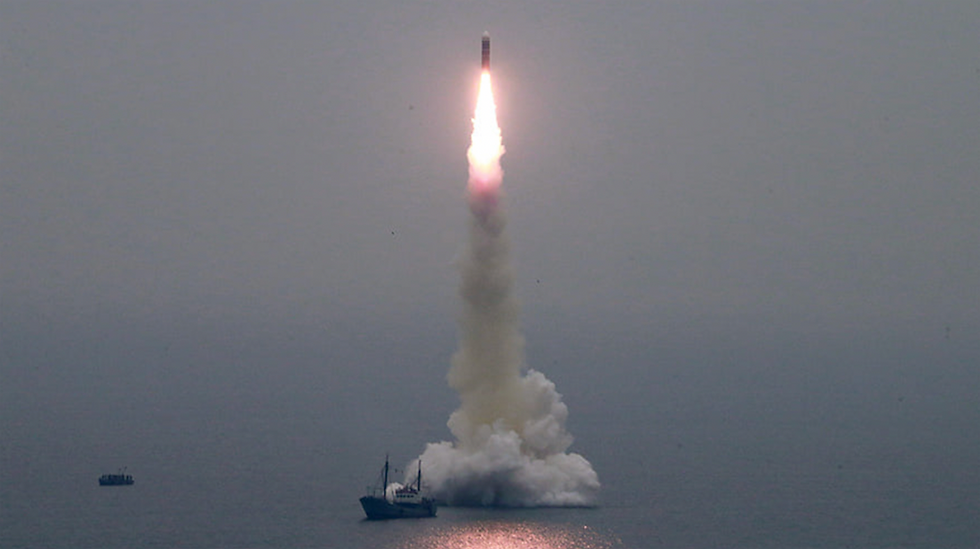
Pukguksong-3 (KN-26)
Over the next few years, North Korea continued launching short-range missiles, but began experimenting with new projectile technology. On October 2nd, 2019, a new-type submarine-launched ballistic missile (SLBM), the Pukguksong-3, was successfully launched in the waters off Wonsan. It travelled 450km and was thus labelled as an intermediate-range missile. On September 11th, 2021, the Korean Central News Agency (KCNA – North Korea’s main news platform) reported tests of another new technology, a long-range cruise missile. The technology enabled missiles to travel at a constant speed over a long distance, hence its name. The test was successful, and the missile hit its target after flying for a distance 1,500km. It had been labelled as having the capability to play a “strategic role”, which analyst Ankit Panda stated was a genteelism way of referring to the missile’s ability to carry nuclear warheads.

Railway-borne missile launch
North Korea continued developing and testing new technology; on September 15th, 2021, two unidentified ballistic missiles were launched towards the Sea of Japan. Part of a new technology that uses a railway-borne regiment, “the railway-borne missile system serves as an efficient counter-strike means capable of dealing a harsh multi-concurrent blow to the threat-posing forces”, said Pak Jong Chon, a North Korean marshal and member of the Presidium of the Politburo of the ruling Workers’ Party of Korea. Railway-borne missiles are considered to be relatively cheap and reliable, and their portability makes them easy candidates for development when considering North Korea’s resources. According to the KCNA, there are plans for expansion of the railway-borne regiment to a brigade-size force, and to have the ability to gain “operational experience for actual war”. Other than the railway-borne missile, North Korea also conducted several tests, such as the launch of a new hypersonic missile called Hwasong-8 on September 28th, 2021, the testing of a new anti-aircraft missile on September 30th, 2021, and the ejection of a new SLBM with added features on October 19th, 2021.
2022: What’s Next for North Korea’s Missiles?
It has only been a month since the year started but North Korea has already had several test fires. Despite being under sanctions and in agreement to a moratorium on long-range missile testing, on January 5th, 2022, the country launched its first missile of the year – a long-range. It uses the same technology as the one launched with the same name just a few months before in September, and has the potential to travel 4,500km towards its target. Hypersonic weapons are high-level threats to international airspace, more so than any other weapon produced before, because of its ability to travel nearly under the radar. The missile houses a hypersonic glide vehicle (HGV), and these types of missiles have the ability to cruise towards its target with unpredictable flight paths. Combined with their intense Mach-5 speed (5 times the speed of sound) and incredible maneuverability, they are nearly impossible to track and intercept. The introduction of these new forms of technology are significant as they demonstrate North Korea’s swiftly advancing military capabilities and can therefore pose as a threat.
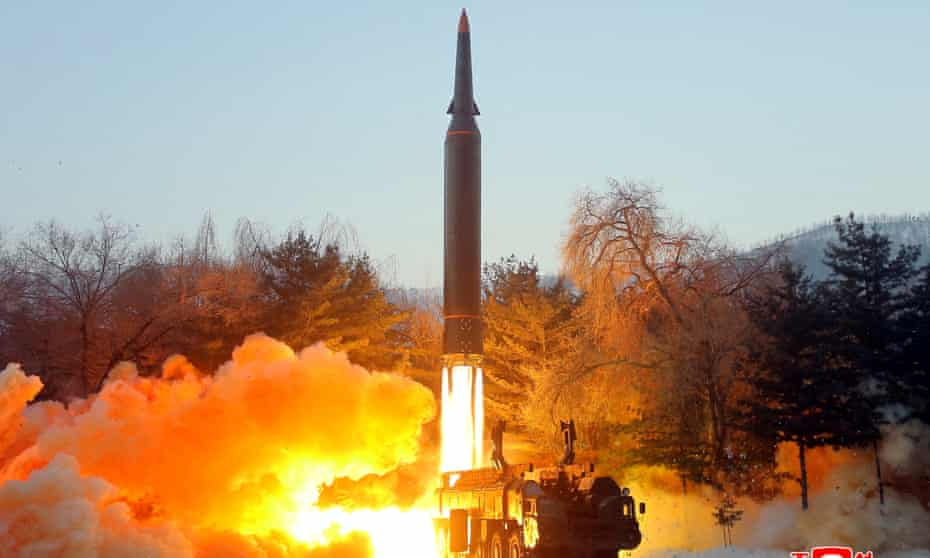
Hypersonic missile test
The development of hypersonic missiles, long-range cruise missiles, short-range ballistic missiles (SRBM) from a railway-based platform, and anti-aircraft missiles are part of a recently discovered five year “defence science and weapon systems” plan. Rarely has there ever been news or knowledge of North Korea’s plans, especially where the military is concerned, but following the launch of these new systems, the KCNA made its first international acknowledgement of the existence of such a plan on September 13th, 2021. The five-year plan had been unveiled at the start of that year, at the 8th Congress of the Workers’ Party of Korea, along with several other military programmes with the aim to be able to “fight a war at the highest level”. The hypersonic missile, the Hwasong-8, is one of the plan’s “five top-priority tasks” and has come during a time of heightened tensions with South Korea as well as with the US. In recent missile testings in 2022, with extra stress placed on the success of Hwasong-8, North Korea has claimed to be amping up their missile systems to “control the hostile forces in the attempts of a military invasion” (Kim Sung, North Korean policy envoy).
Just 5 days later, North Korea test-fired another ballistic missile. The missile reportedly reached speeds of Mach 10 according to South Korea’s Joint Chiefs (JCS), but the JCS has yet to confirm that the missile is to be classified as a hypersonic glide vehicle. Just 5 days later, two more missiles were launched; this time, two KN-23 short-range missiles reaching speeds of Mach 6 were fired from two separate trains. The testing activity was the second launching of a railway-borne missile, and the exercise’s purpose was to gauge the response time and alert posture of the new missile regiment. The KN-23 type is modelled off Russia’s Iskander mobile ballistic missile, which has the ability to use a pull-up maneuver – a move that allows the missile to evade missile defenses. The last of North Korea’s missile activity in January 2022’s has included a test-launch of two long-range cruise missiles fired off the east coast.
What Do These Developments Mean for the World?
North Korea has kept its missile program alive and thriving since its inception. Through countless developments, testings, and launches of various types of weaponry, including satellites, short, intermediate, and long-range missiles, railway-borne and submarine-launched missiles, hypersonic missiles, and nuclear weaponry, North Korea has continued to expand its military capabilities. Despite having been placed under moratoriums and sanctions by countries (China, Russia, US) and organisations (EU, UN), North Korea is undeterred by these limitations and has continued to religiously expand its military arsenal. In recent years, the country has threatened to disregard its sanctions on long-range and nuclear weapon testing, citing the cause to be Washington’s ‘confrontational stance’, where in 2017, the US blacklisted six North Koreans, a Russian, and a Russian firm known to be involved in the missile program.
Each type of missile has the potential to wipe out thousands, regardless of its range or technology. However, the few types that should be closely monitored are the ICBMs and the hypersonic missiles; the former is primarily designed for nuclear weapons delivery, and the latter has the ability to travel nearly undetected. Both have the capabilities to travel far and fast, which means that mass devastation can occur within minutes of its launch, if North Korea intends for it to do so.
The development and launch of the ICBM caused concerns among international leaders and organisations. Because of its incredible travel range, a missile with capabilities like that would essentially be a threat to nearly everyone on the planet. Furthermore, with North Korea's aggressive approach of its military operations, it is likely that the technology can only improve and advance in the future. At present, North Korea possesses missiles that have the one or more of the following abilities: mid-flight course corrections, speeds of Mach 5 and upwards, atmospheric flight levels, and distances of an estimated 9,000km and upwards.
While the exact travel range of the missiles is unknown due to its lofted trajectory, it is likely that they have the range to strike nearly anywhere in the world. As such, it is possible that the countries that face the most danger are South Korea and the US because of their delicate relations and tumultuous history. With the knowledge that North Korea has been in a war with the US for 70+ years, as well as the fact that the US is partly responsible for sanctions imposed on the DPRK’s missile program, these rapidly advancing forms of missile technology can pose major threats to US interests and civil sanctity. However, at present, the United States Indo-Pacific Command has indicated that North Korea's missile activity is not considered to be an immediate threat.
As the month draws to a close, the North Korea has launched 7 missiles so far - the latest of which is an intermediate-range ballistic missile (January 30th). There have been reports that this missile is the longest-traveling missile since November 2017's Hwasong-15, but it's exact distance is unknown. The missile travelled 2,000km upwards, and 800km laterally, and is another indication of the strained relationship and rising tensions between North Korea and the US. This unusual rapid succession of tests indicates the DPRK's desire to pressure the Biden administration over delays in nuclear negotiations as a result of the pandemic. Moreover, North Korea has suffered a decaying economy as a result of the numerous crippling US-imposed sanctions over its long-range missile and nuclear weapons program. As such, it appears that North Korea intends to ramp up its missile development and testing, and may even disregard the moratorium that has been imposed.
Despite countless limitations and imposed sanctions, North Korea's missile program has been able to survive and possibly even flourish. The nation has made rapid advancements in technology, and has been able to explore various methods of launching. With limited information on future plans and intentions, the world must keep one eye open for North Korea - and the potential havoc it may wreak.



Comments