
The Butcher of Plainfield | True Crime #1
- Jan 15, 2024
- 5 min read
*Warning: Contains graphic images
Fact Sheet

The Butcher of Plainfield

America is home to many things weird and wonderful, including some of history’s most morbid and macabre killers. Many of them committed murder in ways far too inhumane for the sane mind to even conjure up, such as one Ed Gein, who would later called the Butcher of Plainfield for his horrifically complexing actions as a serial killer active during the mid-1900s. His specialty? To skin and dismember his victims and fashion the parts into furniture and clothing.
It astounded most people to think that such horrors could be the work of a person, but if anyone were to look at Gein’s childhood, it would become clear to see how he journeyed down such a path.
Early Life
Edward Theodore Gein was born on August 27, 1906, in La Crosse, Wisconsin, U.S. into a family comprising elder brother Henry, father George and mother Augusta.
Like most serial killers, Gein’s childhood was anything but normal. He was raised by a timid, alcoholic father and a religious, overbearing and verbally abusive mother, the latter of whom played an especially significant role in forming Gein’s murderous, bizarre tendencies.
Ed’s father George played a backseat role in Ed’s life, whereas his mother Augusta Gein acted as the power figure in the house. As a religious fanatic, she raised both her children on the same beliefs that ruled her life; she taught her sons that the world was full of evil, that women (aside from herself) were “vessels of sin”, and that drinking and immortality were the instruments of the devil. She constantly warned her sons about the sins of premarital sex, and often preached puritanically about the sins of lust and carnal desire. Despite all this and her abusive treatment of her sons, Ed developed an unhealthy obsession with and devotion to his mother and lived most of his life ruled by her beliefs.
Although Ed followed in his mother’s footsteps and line of thinking, elder son Henry did not do the same. Henry was often concerned with Ed’s intense obsession with their mother and “occasionally confronted her in Gein’s presence”, likely in an attempt to ‘save’ Ed from their mother’s preachings. However, Henry’s words fell on deaf ears. Ed remained fixated on her beliefs and continued to hold her in high regard for the rest of his life.
Henry would not go on to live a very long life. On one night in 1944, both brothers were clearing some vegetation in the field by burning it away. As they worked, the fire suddenly blazed out of control. When firefighters arrived to put out the fire, Ed told them that Henry had vanished. His body was later found face down in the marsh, dead from asphyxiation. At the time, his death was ruled as a tragic accident, but later, some suspected foul play, even going so far as to think it possible that Ed had killed him.
There was never any confirmation on whether Ed killed Henry, but if it were true, then Henry’s death would have marked Ed’s first murder. Not only did his brother’s death begin his killing journey, but the removal of Henry in his life meant that Ed and Augusta had the farmhouse to themselves. Until her death a year later, both mother and son lived “peacefully”.
Before Augusta passed away, Ed spent his life devoted to serving to his mother’s every need. Many parts of Ed Gein’s life formed the basis of his later obsessions. In fact, it was often said that he idolised her, worshipped her, and dedicated his life to her – so much so that later, after her death, Gein became a hermit and withdrew further from society.
Life After Augusta's Passing
Following Augusta’s death, Ed transformed the house into something of a shrine to honour his mother. He blocked off rooms she used, immortalised them and the possessions contained within, and holed himself up in a small bedroom off the kitchen. Living on his own and so far away from home created the perfect environment for him to descend further into his eccentrics and obsessions; he spent his days studying Nazi medical experiments, learning about human anatomy, and consuming porn, all of which set the foundation for his morbid human creations.
Having kept a low profile for most of his life, nothing was suspected about the Gein farm for a decade. The townspeople had little to no dealings with them, so it was only until the mysterious disappearance of a local hardware store owner, Bernice Worden. When she vanished, all that was left behind was bloodstains. Her sudden disappearance prompted an investigation, and because Ed had been her last customer, police paid Ed’s farmhouse a visit.
The Discovery and Investigations
Ed Gein’s macabre creations were stumbled upon during the police investigation of the disappearance of local hardware store owner Bernice Worden, whose last sale had been a gallon of antifreeze to Gein. Gein was arrested later the same day Worden has been discovered missing, and promptly had his house searched.
A sheriff’s deputy found Worden’s decapitated body in a shed, where she had been hung upside down by her legs. Shot by a .22-caliber rifle, her wrists were rope-bound and entire body mutilated post-death. This initial discovery led to further searching of Gein’s house, where authorities found:
Whole human bones and fragments
A wastebasket made of human skin
Human skin covering several chairs
Skulls on his bedposts
Female skulls, some with the tops sawn off
Bowls made from human skulls
A corset made from a female torso skinned from shoulders to waist
Leggings made from human leg skin
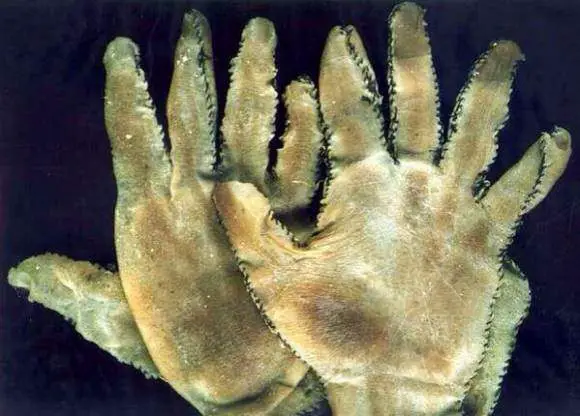
Gloves made from human hands
Masks made from the skin of female heads
Mary Hogan's face mask in a paper bag
Mary Hogan's skull in a box
Bernice Worden's entire head in a burlap sack
Bernice Worden's heart "in a plastic bag in front of Gein's potbelly stove
Nine vulvae in a shoe box
A young girl's dress and "the vulvas of two females judged to have been about fifteen years old"
A belt made from female human nipples

Four noses
A pair of lips on a window shade drawstring
A lampshade made from the skin of a human face
Fingernails from female fingers
Gein later confessed to a number of crimes, all of which corroborated with evidence and discoveries from his house. He admitted to stealing from nine graves, and had made as many as forty visits to three local graveyards (though on occasion, he left the graves in good order and returned home emptyhanded). He also admitted to shooting 51-year-old tavern owner Mary Hogan, who had been missing for nearly 3 years.
His obsession with his mother was cited as the motivation for some of his actions. Some of the graves he dug up were of middle-aged women he thought resembled his mother. He would tan their skins and use them to make his creations. Gein also created a "woman suit" so that "he could become his mother and literally crawl into her skin."
Gein was also marked as a suspect in several other unsolved cases in Wisconsin, including the disappearances of:
Georgia Jean Weckler, 8 years old
Evelyn Grace Hartley, 15 years old
Victor Harold Travis, 41 years old
He was also tentatively linked to the missing cases of:
James Walsh, 32 years old
Irene Keating, 30 years old
Judy Rodencal, 16 years old
Aftermath
Gein was arraigned on one count of first degree murder in Waushara County Court on November 21, 1957, where he pleaded not guilty by reason of insanity. He was diagnosed with schizophrenia and found mentally incompetent, thus unfit for trial. He was sent to the Central State Hospital for the Criminally Insane (now the Dodge Correctional Institution), a maximum-security facility in Waupun, and later transferred to the Mendota State Hospital in Madison.
Modern Media

Gein has served as the inspiration for several horror icons, including Norman Bates (Psycho), Leatherface (Texas Chainsaw Massacre), Bloody Face (American Horror Story: Asylum), and Buffalo Bill (The Silence of the Lambs) just to name a few.
Further Reading
Comments